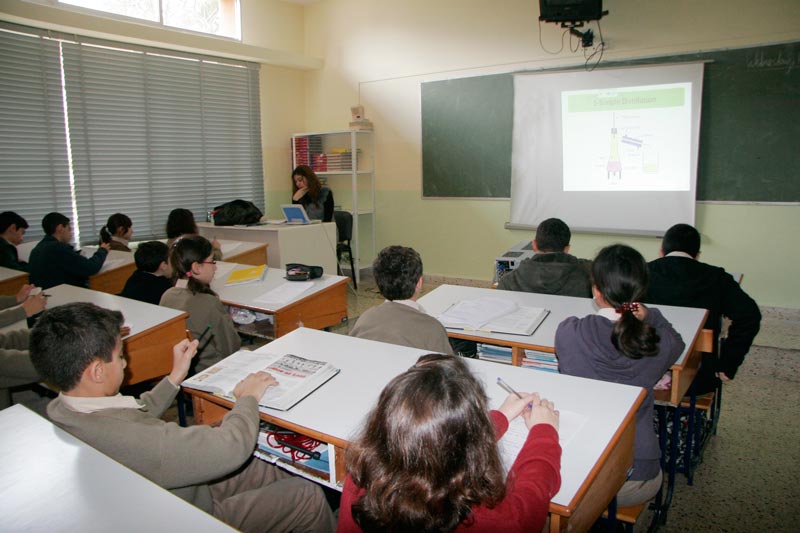
Most science instructions are based on a traditional didactic approach grounded in lecture- and textbook-based instructions. Science educators have long recognized the importance of including the use of animated websites and virtual labs for promoting meaningful learning of science processes and concepts. This trend is applied at our schools through the facility of using an LCD projector, web connection and laptops. These powerful tools expand classroom resources. They bring information, data, images, and videos which suit the lesson taught. Our learners can now give their textbooks a break in classes, and use the internet instead.
In our science classes, textbooks don't always get the point across learners’ minds. Seeing abstract ideas in a concrete figure on computer screen makes it a better picture in the learner’s head, yet a better way to understand and visualize scientific concepts. For example, our Upper Elementary learners saw some interesting websites about moving atoms, electrons bouncing, unstable isotopes and atoms emitting radiations. They saw animated covalent and ionic bonds sharing and giving electrons.
Moreover, the virtual laboratory activities facilitate collaborative scientific inquiry among learners and promote conceptual change in our learners' understanding of scientific phenomenon through online multimedia simulations and computer-mediated discussions. These online activities allow learners to construct their own scientific knowledge through investigation rather than memorization of concepts believed to enhance some skills they need to become life-long science learners. For example, learners worked in collaboration to test whether some solutions are acids or bases, and how to separate mixtures and solutions. Therefore, virtual Lab helps students to look inside the things we use everyday to see how they work as well.
Roula Sarouja
Upper Elementary Science Teacher
View Photos | Go to News listing